Horizontal stack: the basic offence
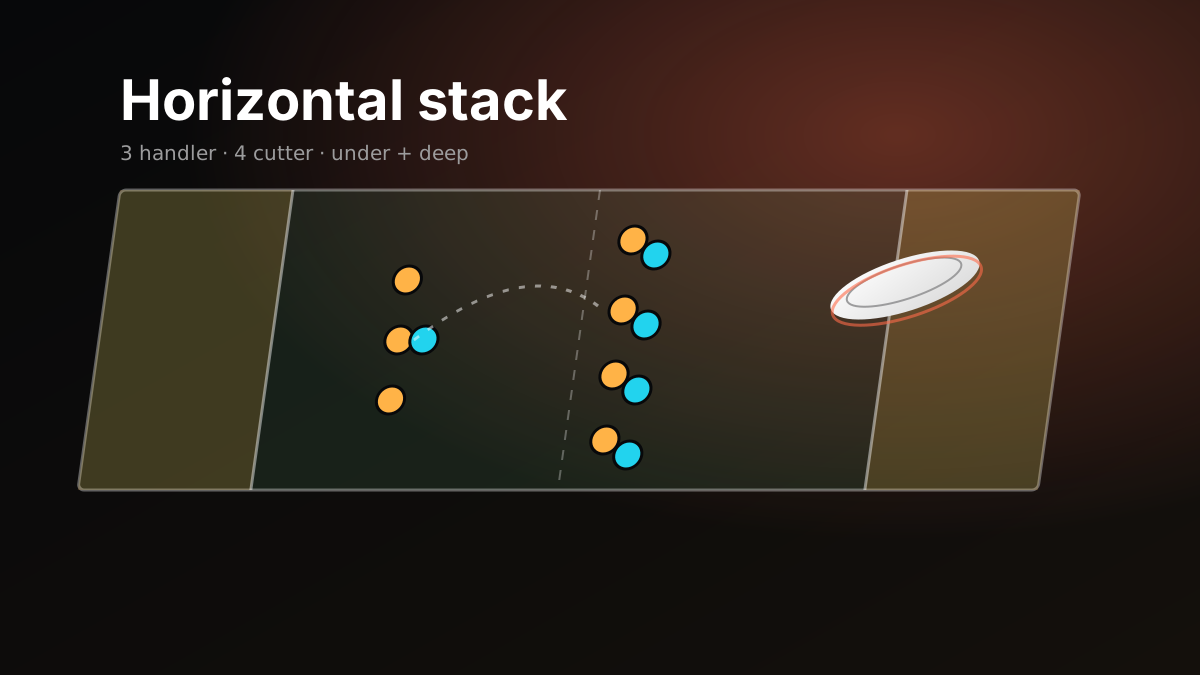
The first post showed the vertical stack: cutters in a line down the middle, open lanes on both sides. The horizontal stack (“ho stack”) turns the same idea sideways: the cutters stand 15-20 metres in front of the disc in a line across the width of the field. The open space is now in front of and behind the cutters rather than beside them.
It is the most common club-level offence today, for a simple reason: every cutter has room to run into, and the defence cannot easily guess who is going where.
The formation
Seven players split into two groups:
- 3 handlers back, level with the disc. The middle one holds it; the other two are the “reset” options.
- 4 cutters 15-20 metres downfield, spaced 8-10 metres apart.
The one thing to learn like a rule is the distance. Too close to the disc and the “under” space disappears; too far and the throws do not arrive. 15-20 metres is a good starting point.
The under cut
The most used cut. The cutter first takes a few steps deep (pushing the defender back), then turns hard and comes towards the disc. The handler throws into the space in front of the cutter. On the catch, that cutter becomes the new handler and the whole formation moves 15-20 metres downfield.
Notice that the throw goes to where the cutter is running, not to the cutter. The defender is behind and cannot reach it.
The deep cut
Once the under has burned a defender, they start cheating: they sit in front, expecting the cutter to come back to the disc. That is the moment to do the opposite and go deep. The handler throws the long pass (a huck) into the end zone.
Under and deep feed each other. The defender has to take one away; the cutter’s job is to see which one and take the other.
Swing and continuation
If no cutter gets open (the stall count reaches 6 or 7), the disc is swung to a side handler. This is not a step backwards: once the disc is on the other side of the field, the angles in front of the cutters change and a new under opens up for the cutter waiting on that side. That pass, thrown the moment the swing is caught, is the continuation.
Common mistakes
- Everyone cuts at once. One cut at a time. The others hold their spot or clear away to make room.
- Standing in the middle after a cut. If the throw did not come, get back to the line immediately; a cutter loitering in the lane brings two defenders with them.
- Handlers running with the disc. A handler’s job is to think fast, not run fast. Think swing at stall 6, do not wait for 8.
- The line drifts towards the disc. After every catch the cutter line should move so it stays 15-20 metres ahead.
Next post: the defensive side, the force and the mark. Limiting the handler’s throwing side is the most effective first step against a horizontal stack.