What is ultimate frisbee?
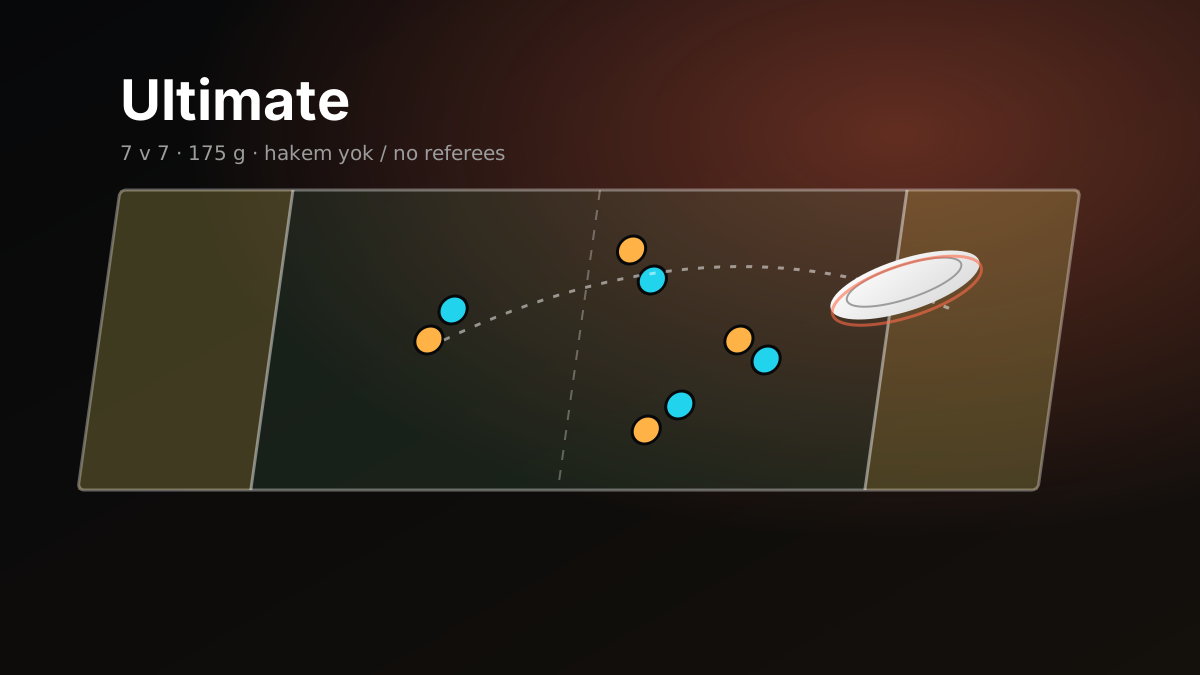
Ultimate is a 7-on-7 team sport played with a 175 gram disc. It borrows the field from American football, the passing game from basketball and the pace from football; its defining feature is that there are no referees. Players call their own fouls.
This post is the ten-minute explanation I would give someone who has never played. Tactics posts will follow in this category, and they will reuse the field diagrams below.
A short history
- 1968, New Jersey. Students at Columbia High School (among them Joel Silver, later a film producer) write down rules for a disc game played in the school car park.
- 1972: The first intercollegiate game, Rutgers against Princeton. Rutgers wins 29-27.
- 1979: The first national governing body is founded in the US (today’s USA Ultimate).
- 1985: The World Flying Disc Federation (WFDF) is founded and the rules become international.
- 2013: WFDF is recognised by the International Olympic Committee. More than 40 countries entered the 2022 world championships.
In Turkey the game arrived in the mid-2000s through university clubs; today Istanbul, Ankara and Izmir have regular leagues and mixed tournaments.
Field and disc
The field is 100 metres long and 37 metres wide. Each end has an 18 metre end zone; the 64 metres in between is the playing field. The standard disc weighs 175 grams and is 27 centimetres across.
Every point starts with a pull: the defending team throws the disc from its own end zone to the other side, the offence catches it or picks it up, and play begins. In the animation above, yellow is pulling.
Core rules
- No running with the disc. Whoever catches it keeps one foot planted (the pivot) and can only pass.
- A point is scored by catching a pass inside the opponent’s end zone. Teams switch ends after each point.
- Turnover: if the disc hits the ground, goes out of bounds, is intercepted, or the thrower does not release it within 10 seconds (the defender counts out loud, the stall count), possession changes. Play does not stop; the defence attacks immediately.
- No contact. Running into a player going for the disc is a foul. The player calls it; if the other side agrees the disc goes back, if not it returns to the previous thrower.
- No referees. This is the Spirit of the Game: following the rules, resolving disputes calmly and respecting the opponent count as much as the play itself. At international tournaments teams score each other on spirit.
Games are usually played to 15 points and take about 90 minutes. There are women’s, men’s and mixed divisions; in mixed, 3 or 4 of the 7 players on the field are women.
How it is played: the pass and the cut
The smallest unit of offence is two people: the handler holding the disc and the cutter running into open space. The cutter first steps one way to shake the defender, then turns hard towards the disc. That is when the handler throws.
Three things to notice:
- The cutter runs towards the disc, not away from it, so the defender is always a step behind.
- The handler throws to where the cutter will be, not where they are.
- After the throw the handler does not stand still; they run into new space and become the next cutter.
The vertical stack
The first formation most new teams learn is the vertical stack: the cutters form a line down the middle of the field, leaving wide open lanes on both sides. They cut one at a time; if a cut is not thrown to, the cutter returns to the line and the next one goes.
That is the whole game. Next posts will cover the horizontal stack, zone defence and the idea of a force, using the same diagram component.
Where to start
One disc (the Discraft Ultrastar is the standard) and four people are enough. For a first session, learn the backhand and forehand throws, then play 3-on-3 “mini”. If your city has a club, most run open practices for beginners; just turn up and ask.