Zone defence: the game for windy days
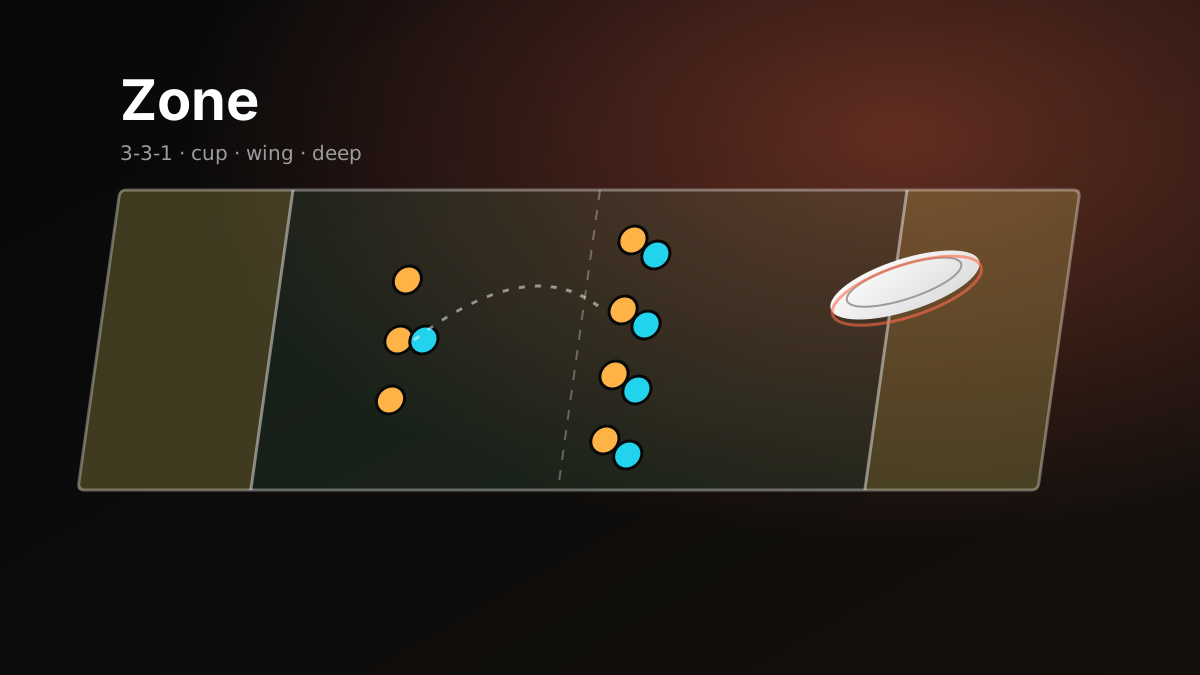
Everything so far has been person defence: each defender has a cutter. The force is built on top of it. But when the wind picks up, or the opponent throws long passes too well, teams switch to something else: the zone. Defenders guard an area of the field rather than a player.
The logic is simple. In wind, long and sideline throws are risky and short throws are safe. A zone makes the short throws tiring and the long ones impossible, then waits for the offence to make a mistake somewhere in the next thirty passes.
The 3-3-1
The most common zone is the 3-3-1: three players around the disc (the cup), three across the middle (two wings and a mid), one at the back (the deep).
The jobs:
- Cup: three players form a crescent in front of the thrower. The middle one counts the stall like a mark; the two on the sides close the short and medium throwing lanes. The cup’s aim is not to get the disc but to leave the thrower only backwards and sideways options.
- Wings: guard the sideline strips. The wing on the disc’s side moves in towards the cup; the far wing watches the wide open space.
- Mid: guards the hole behind the cup. The hardest job in the zone, because the offence tries to put a player exactly there.
- Deep: lets nobody behind. If a long throw goes up, the deep is most likely there.
The cup moves with the disc
A zone does not stand still. When the disc goes from one handler to another, all three cup players run to the new thrower. The run has to be fast: if the cup is late, the new thrower has a free look for a moment, and that moment is exactly what the offence waits for.
The cup shift is the heart of the zone. A team trying it for the first time spends half the practice on just that run.
Beating the zone
There are two tools against a zone, and both need patience.
Swing: move the disc quickly from one side to the other. Every swing makes the cup run 15-20 metres; by the third or fourth the cup is tired and late. The first throw in front of a late cup is easy.
Popper: one offensive player darts into and out of the hole behind the cup. While the cup is busy surrounding the disc, a short 8-10 metre throw to the popper beats all three of them. The mid tries to cover it, but with two poppers one mid cannot.
A team that combines the two breaks the zone apart: swing, swing, pop. While the cup runs one way, the popper enters the hole from the other.
When to zone, when to play person
- Wind above 5 m/s: zone. Long throws are already off the table and short throws produce errors.
- A fast but impatient opponent: zone. Without the discipline for thirty passes, the disc drops.
- An opponent with excellent handlers: person. Good handlers wear a zone out with swings.
- A critical point: most teams go back to what they know, which is person defence.
Practise the zone without an offence first: seven defenders, a coach on the sideline pointing to where the disc is, the cup running. The shift has to be a reflex before you add an offence.
With these four posts the basic tactical vocabulary is complete: stack, force, zone. From here on it is practice and games.